Booking choice: The Duomo rooftop and cathedral guided tour, 2 hours. Book this Tour details
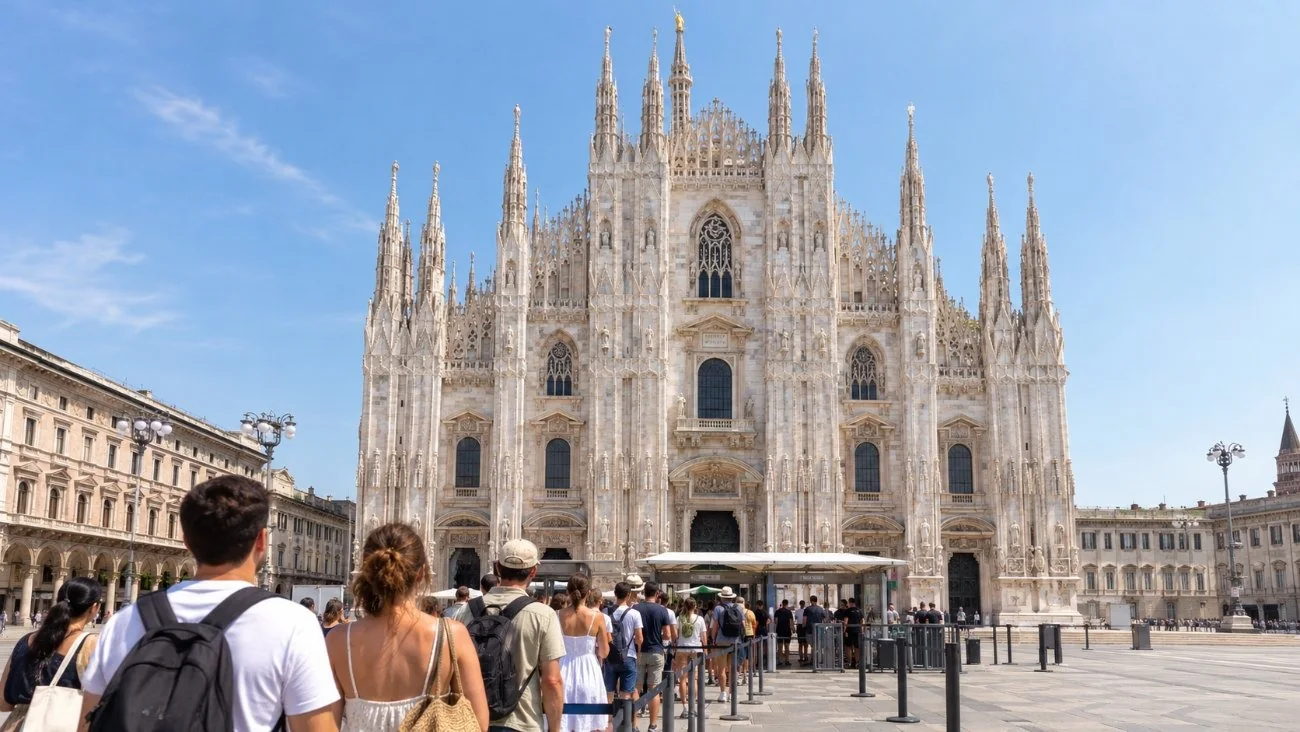
Most cathedrals have a building history. The Duomo has a building body, and that is the difference. The Veneranda Fabbrica del Duomo was set up in 1387 to raise the church and has never been dissolved; it owns the marble quarry, employs the stonemasons, runs the museum and prints the tickets. When the Fabbrica says construction ended in 1965, it means the day the fifth bronze door went in, and when it says the work never ends, it means the scaffolding you will see on at least one spire.
This guide takes the long story in eight questions: who started it, what the Fabbrica is, where the marble comes from, how long it took, what Napoleon did, how the Madonnina got up there, when it was finished, and whether UNESCO lists it. Spoiler on the last: no.
The quick answer
Begun in 1386 under Archbishop Antonio da Saluzzo and Gian Galeazzo Visconti, run from 1387 by the Veneranda Fabbrica, built of Candoglia marble from Lake Maggiore, topped by the Madonnina in 1774, given its facade on Napoleon's orders between 1805 and 1813, and declared finished when the last bronze door was hung in 1965. Not a UNESCO site. Owned and run by the Fabbrica to this day.
Who had the Duomo di Milano built and when?
Work began in 1386 under Archbishop Antonio da Saluzzo, with Gian Galeazzo Visconti, lord and then duke of Milan, as patron and paymaster.
Milan already had two cathedrals on the site, Santa Maria Maggiore and Santa Tecla, whose foundations you can still walk among under the parvis. In 1386 the archbishop began a new one, and his cousin Gian Galeazzo Visconti, who had seized the city the year before, turned it into a statement of his rule. The first chief engineer, Simone da Orsenigo, planned a brick church in the Lombard Gothic manner; within three years the project had been pushed toward French Rayonnant Gothic by engineers brought from across the Alps, Nicolas de Bonaventure among them, and the brick had become marble.
The apse went up first, which is why the oldest glass and the oldest carving are at the east end. By the time Gian Galeazzo died of plague in 1402, roughly half the building stood. Then the money slowed, and the next five centuries happened.
What is the Veneranda Fabbrica del Duomo?
The body founded in October 1387 to build and maintain the cathedral. It still does, and it owns the quarry, runs the museum and sells the tickets.
Fabbrica means works, and that is what it was: a board, a treasury, a workshop and a workforce dedicated to this one building. Its first statute dates from 16 October 1387, the date the Fabbrica keeps as its anniversary and one of its free-entry days. It was endowed with land, gifts and the Candoglia quarry, and it kept going through the Sforza, the Spanish, the Austrians, Napoleon, the kingdom and the republic.
Who owns the Duomo today, then, is the Fabbrica: an ecclesiastical body under Italian law, not the state and not the city. That is why the Duomo has its own ticketing, its own free days and no part in the state museums' first-Sunday scheme, and why the restorers you see on the roof are its own employees. The Fabbrica's calendar is still the authority on what is open when.
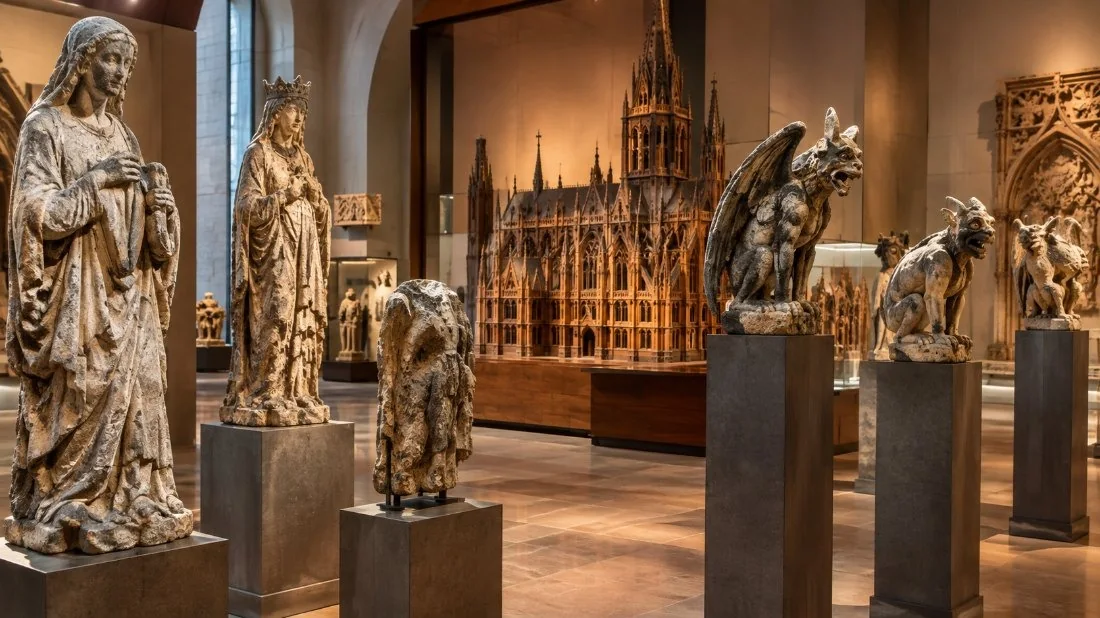
Where does the Duomo's marble come from?
From Candoglia, above Mergozzo on Lake Maggiore, a quarry granted to the Fabbrica in the 1390s and still worked by it today.
The marble is pink-white with grey veins and weathers to the grey you see on the untouched parts of the building. Gian Galeazzo gave the Fabbrica the exclusive use of the quarry, and the blocks came down by water: Lake Maggiore, the Ticino and the Navigli canals into the heart of Milan, to a dock a few streets from the site. The barges carried the mark AUF, ad usum fabricae, for the Fabbrica's use, which exempted them from tolls; Milanese still say a uf for anything got for free.
The Fabbrica's quarry page describes the Candoglia works it still runs, and one of its free guided visits goes there. A spire replaced today is cut from the same hillside as one carved in 1400, which is the only reason the roof looks like one building.
How long did the Duomo take to build?
578 years by the Fabbrica's count, from the first stone in 1386 to the last bronze door in 1965, with long pauses and a dome, a spire and a facade each a century apart.
The timeline below picks the dates that matter. The pattern is a burst of building when a ruler wanted it, then decades of slow stone-cutting. The octagonal tiburio over the crossing was argued over for years, with Leonardo and Bramante among those who submitted models in 1488 before Amadeo and others built it between 1500 and 1510. Carlo Borromeo brought in Pellegrino Tibaldi in 1571 and reshaped the interior; his Roman-style facade was never built. Nineteenth-century Milan added most of the spires and new glass. The twentieth century added the doors.
| Year | What happened |
|---|---|
| 1386 | Construction begins at the apse under Archbishop Antonio da Saluzzo |
| 1387 | The Veneranda Fabbrica del Duomo is founded; first statute 16 October |
| 1389 | French engineer Nicolas de Bonaventure arrives; Candoglia marble granted to the Fabbrica |
| 1402 | Gian Galeazzo Visconti dies; about half the building stands |
| 1418 | Pope Martin V consecrates the high altar |
| 1500 to 1510 | The tiburio over the crossing is completed; Amadeo's little spire follows |
| 1577 | Carlo Borromeo consecrates the church after Tibaldi's reworking of the interior |
| 1774 | The Madonnina is raised to the main spire, late December, without ceremony |
| 1805 | Napoleon, crowned King of Italy in the Duomo on 26 May, orders the facade finished |
| 1813 | The facade is completed |
| 1943 | Allied bombing damages the cathedral; repaired after the war |
| 1965 | The fifth bronze door is inaugurated on 6 January; the Fabbrica calls the building finished |
Two hours with a Milanoguida guide puts the dates on the stones: the nave, the lift to the roof, then the museum where the originals and the models are kept. Free cancellation up to 24 hours before.
Book thisWhat did Napoleon do to the Duomo?
He was crowned King of Italy under its vault on 26 May 1805 and ordered the unfinished facade completed; it was done by 1813, at the Fabbrica's expense.
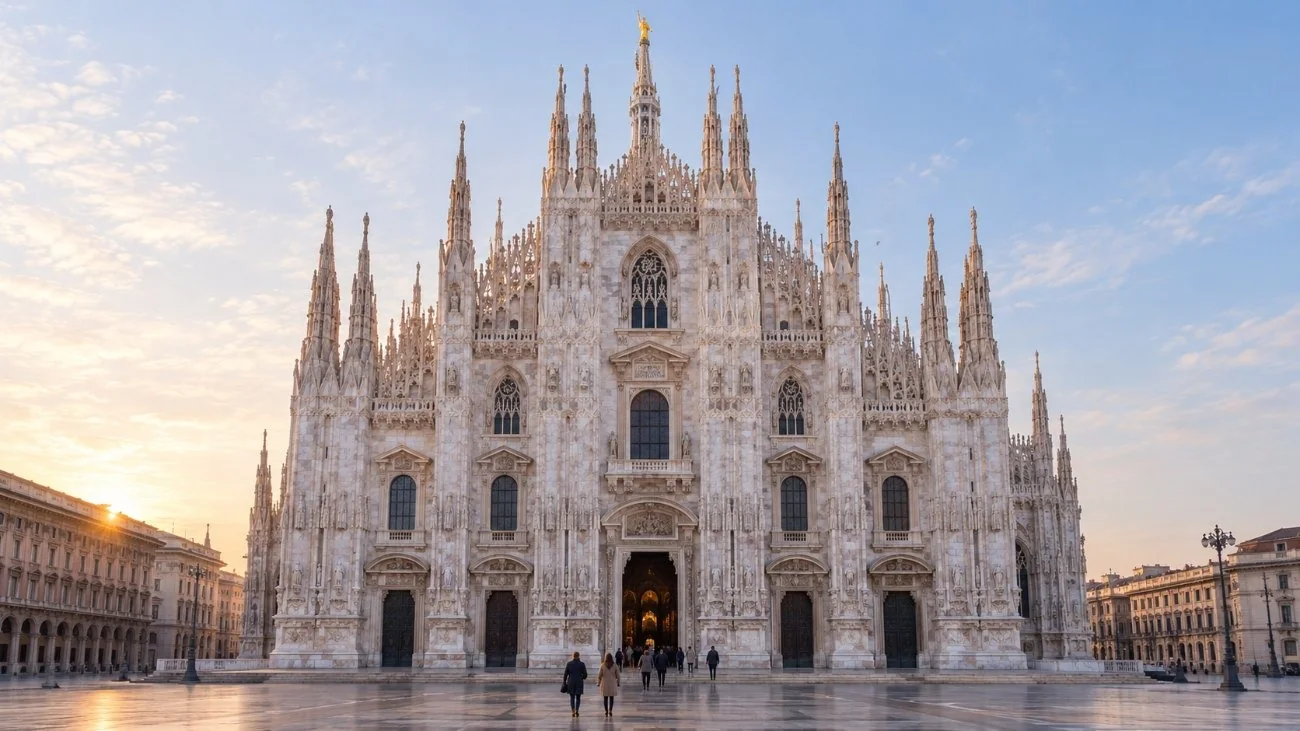
The facade had been a building site for two centuries. Carlo Buzzi's Gothic design of the 1640s had stalled at the five portals and two windows, and the baroque-versus-Gothic argument had never been settled. Napoleon settled it by decree: finish it, in the Gothic manner, and the French treasury would pay. Carlo Amati and Giuseppe Zanoia pushed the work through in seven years and the bill, in the end, stayed with the Fabbrica. In thanks, a statue of Napoleon was put among the saints on one of the spires, where it still is.
The coronation itself used the Iron Crown of Lombardy, brought from Monza, and the line Napoleon is said to have spoken, that God gave it to him and woe to whoever touched it, belongs to that morning. Look for the bronze doors below the facade when you leave: they are a century younger than the marble around them.
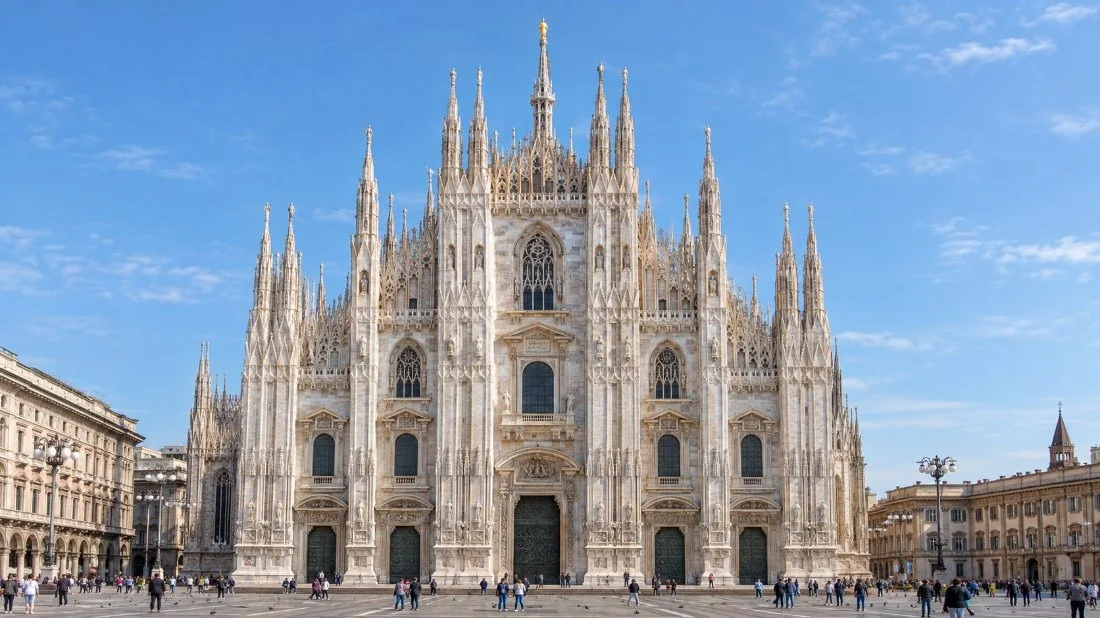
What is the Madonnina and why was nothing allowed to be taller?
The gilded copper statue of the Virgin on the main spire since December 1774, 108.5 metres up. A 1930s rule kept Milan's buildings below her, and the towers that passed her carry a copy.
The Fabbrica's Madonnina page has the numbers. Giuseppe Perego sculpted her in 1769 from three proposals; the goldsmith Giuseppe Bini hammered 33 copper sheets, 399.2 kilograms of copper, over a wooden form; she was gilded in 1773 and 1774 on the advice of the painter Anton Raphael Mengs, and raised to the top of the main spire in late December 1774 with no ceremony at all. She is 4.16 metres tall. In 1967 she came down for seven weeks, was re-gilded, and had her iron skeleton replaced by a stainless-steel one weighing 584.8 kilograms; the old frame is in the museum. In 2012 she was gilded again with 6,750 gold leaves. Her halberd is the lightning rod.
The height rule came in the 1930s: nothing in Milan was to stand above her. When the Pirelli tower passed her in 1960, a copy of the Madonnina went on its roof to keep the letter of the rule, and copies now stand on the UniCredit tower at Porta Nuova and the Dritto at CityLife. On certain days a tricolour flies from her halberd, a habit that goes back to the Five Days of 1848.
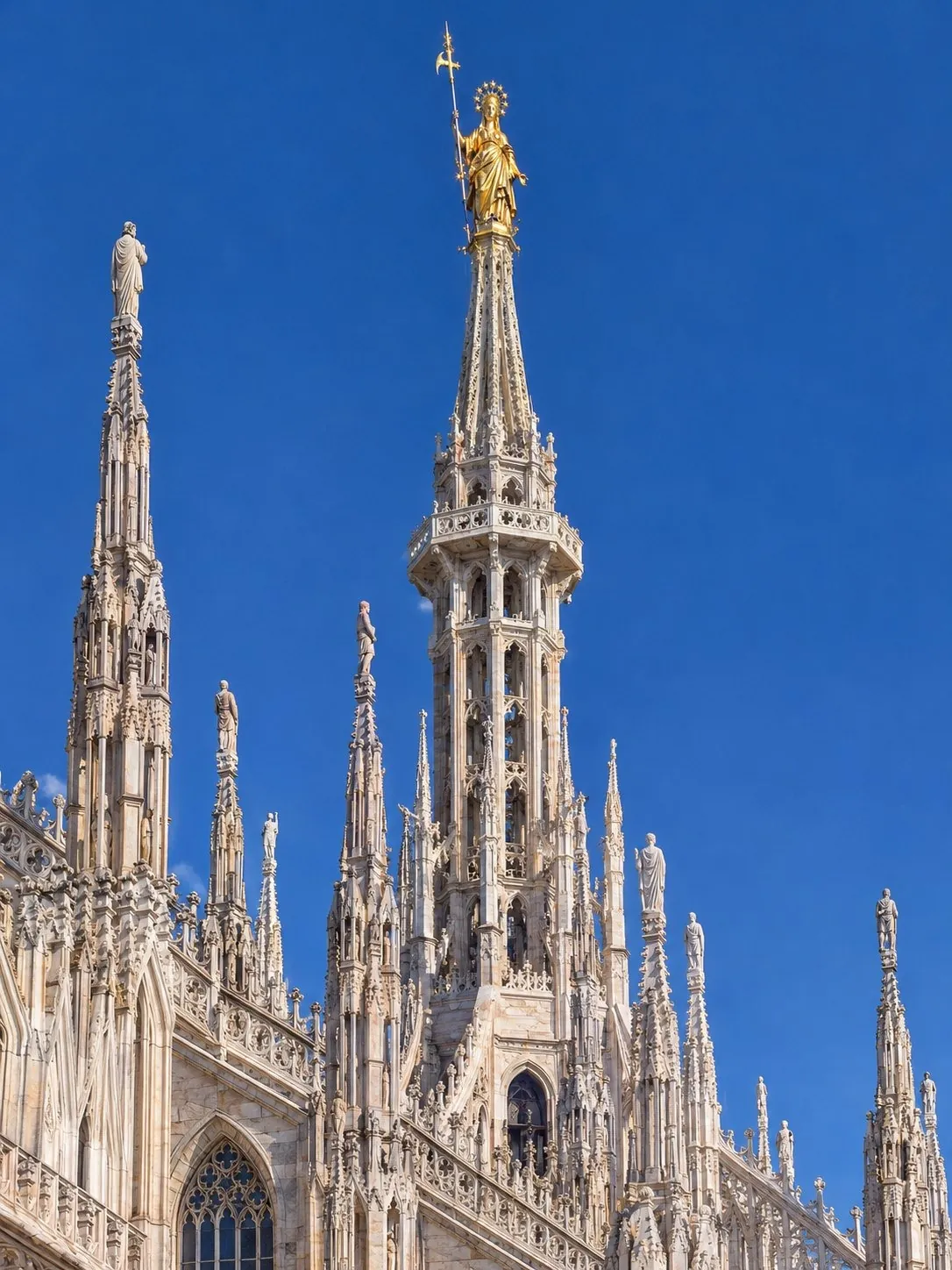
When was the Duomo finally finished?
On 6 January 1965, when the fifth bronze door was inaugurated. The Fabbrica counts that as the end of construction, 578 years after the first statute.
The facade got its doors in the twentieth century. Lodovico Pogliaghi's central door, with the joys and sorrows of the Virgin, was unveiled in 1906 and completed in 1908. The four side doors replaced wooden ones after the war: Arrigo Minerbi's door of the Edict of Constantine in 1948, Giannino Castiglioni's door of St Ambrose in 1950, the door of Milan's history and the battle of Legnano begun by Franco Lombardi and completed by Virginio Pessina the same year, and last, Luciano Minguzzi's door of the Duomo's own history, twelve scenes from the founding to the age of St Charles, in 1965.
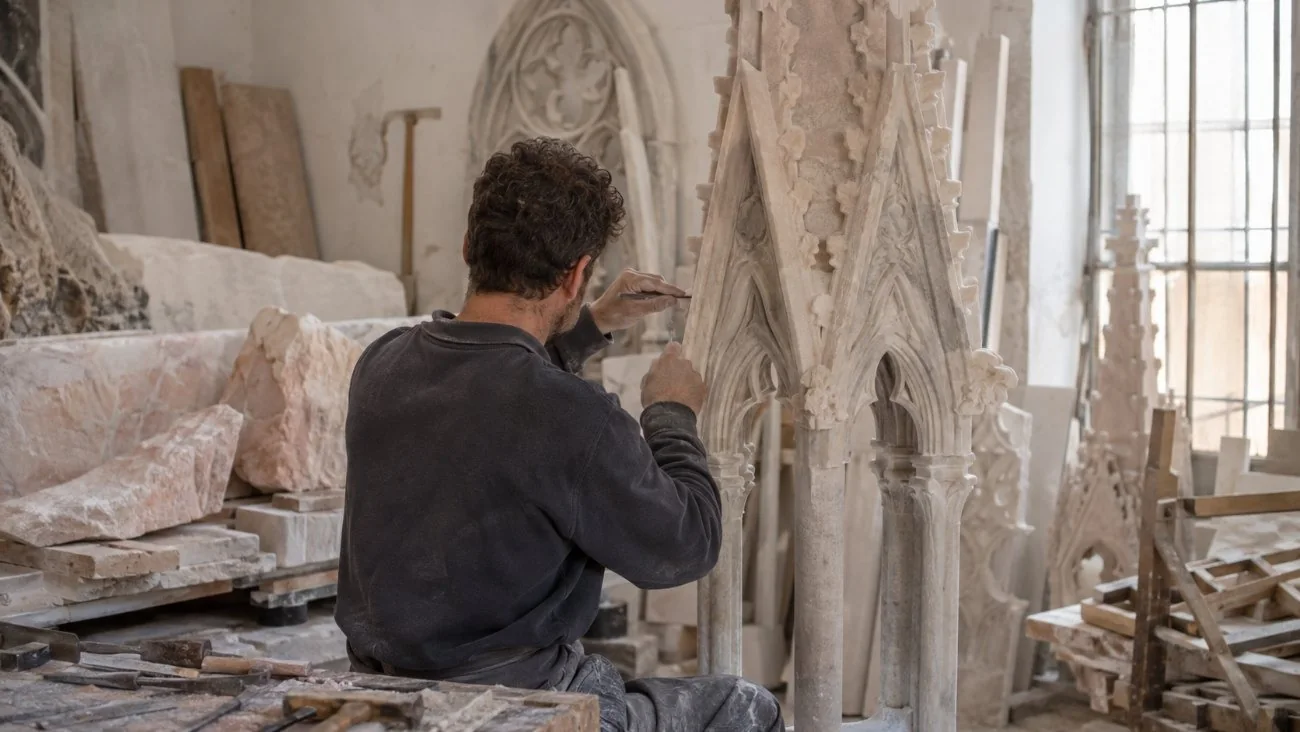
Finished is a relative word here. The 1943 bomb damage was repaired, the facade was cleaned from 2003 to 2009, and the Fabbrica's stonemasons replace weathered spires and statues from Candoglia blocks as a matter of routine. There is always scaffolding somewhere on the roof, and the Fabbrica lets you adopt a spire to pay for it.
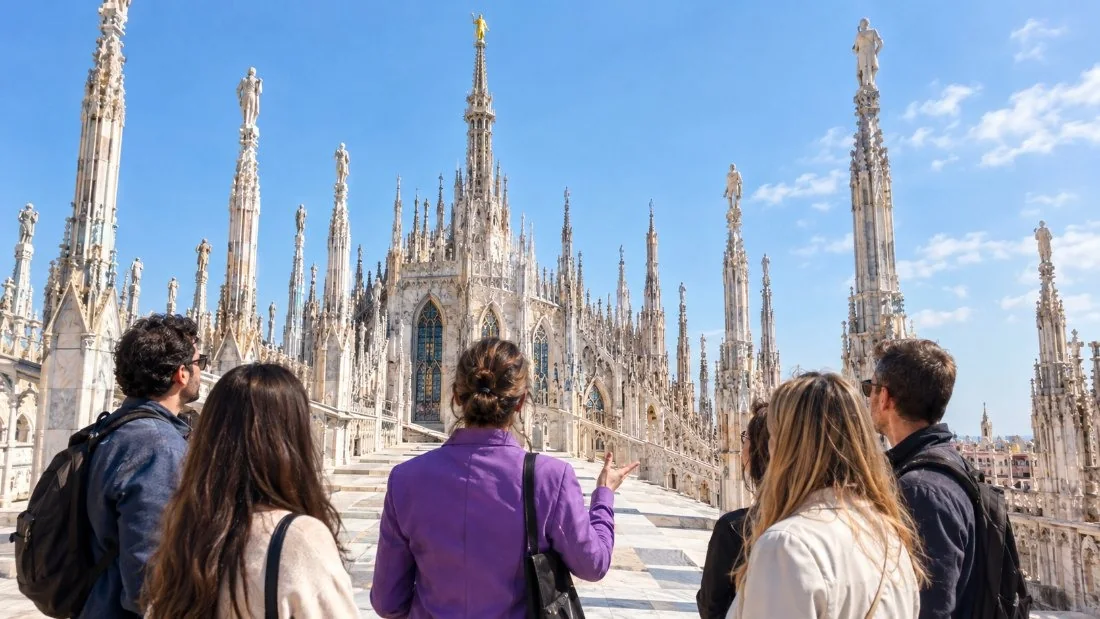
A guide in six languages walks the nave and rides the lift to the roof, with priority entry to the museum and San Gottardo afterwards. Free cancellation up to 24 hours before.
Book this Tour detailsIs the Duomo di Milano a UNESCO World Heritage Site?
No. Italy put it on its Tentative List in 1996 and took it off in 2005; a new candidacy was discussed in 2023 and has not been submitted.
People assume it must be, and it is not. Milan's World Heritage site is Santa Maria delle Grazie with Leonardo's Last Supper, a twenty-minute walk west. The Duomo's absence has nothing to do with its merit and a lot to do with the paperwork: an Italian tentative listing in 1996 was withdrawn in 2005, and the idea came back in the city's newspapers in May 2023. Until a nomination is filed and judged, the honest line is the one on this page.
For the building that is listed, the Duomo and Last Supper tour pairs the two in one walk. For the one that is not, any ticket in our ticket guide will do.
Frequently asked questions
How much gold is on the Madonnina?
The 2012 regilding used 6,750 gold leaves over the 33 copper sheets, per the Fabbrica. The statue itself is copper, 399.2 kilograms of it, on a stainless-steel frame fitted in 1967. Nobody is allowed up to check, and she has never been stolen.
Who is buried in the Duomo?
St Charles Borromeo, archbishop, who died in 1584, lies in the Scurolo under the altar; the archbishops of Milan are in the crypt beside it. In the right aisle is the monument of Gian Giacomo Medici, the Medeghino, by Leone Leoni, and the tomb slab of Pope Martin V.
Was the Duomo bombed in the war?
Yes. Allied raids in 1943 damaged the cathedral and the area round it, and the wooden side doors were among the losses, which is why four of the five bronze doors date from 1948 to 1965. The marble was repaired after the war.
Why does the Duomo have a different look from other Italian cathedrals?
Because it is French Gothic in an Italian city. The engineers Gian Galeazzo brought from France and Germany in the 1390s gave it the pinnacles, flying buttresses and forest of spires that Italy otherwise avoided, and the marble gave it the colour.
Ready to book
Choose your ticket
Each option opens on GetYourGuide with the operator named and the inclusions listed.
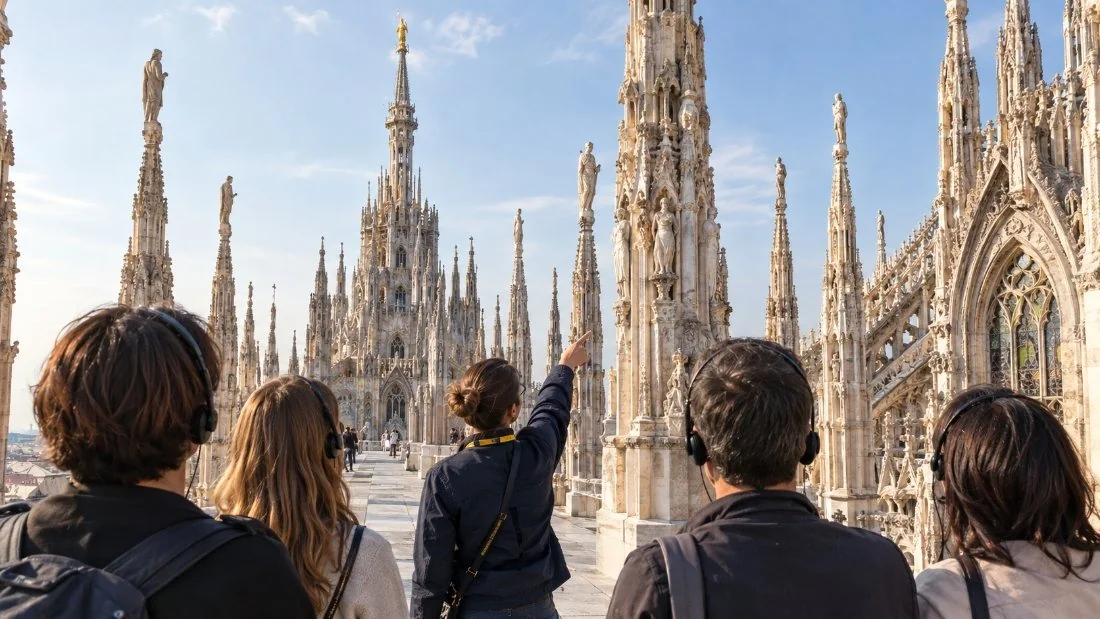
Duomo Rooftop and Cathedral Guided Tour
- Skip-the-line tickets for the cathedral and the terraces, lift up
- Live guide in English with headsets
- Guided visit of the Duomo Museum and San Gottardo Church
Cathedral and Rooftop Terrace Guided Tour
Lift to the roof and a guide in English, Spanish, French, German, Japanese or Russian